
Build a Life You Love.
Learn the money principles that help make it possible.
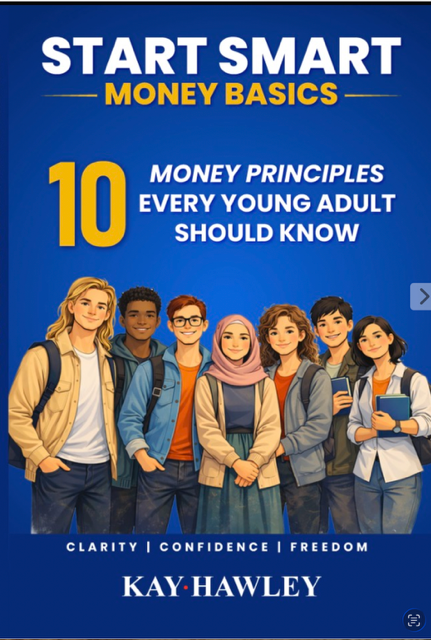
Start Smart Money Basics brings financial literacy down to earth. It connects the real money decisions young adults face every day to the future they want to create. The book uses real stories and ten clear money principles to show how spending, saving, and steering clear of common mistakes add up over time. Confidence grows one decision at a time.
Many books about money are written for people who already speak the language of finance. This one isn’t. Kay Hawley explains money in plain language because she spent more than 35 years as a public school educator, making hard things clear for the people in front of her. Along the way, she taught financial awareness to hundreds of adults in her “Plan Now, Smile Later” workshops.
It reads less like a financial expert talking over your head and more like a trusted teacher sitting beside you.
Listen to the Start Smart song here:

For parents, grandparents, and mentors
Looking for a graduation, birthday, or first-apartment gift that lasts? Start Smart Money Basics is the book many adults wish someone had handed them at eighteen. It opens the door to real conversations about money, work, and the choices that shape a life.
For educators and schools
Start Smart Money Basics supports the financial literacy standards schools are working toward, and it fits alongside the personal finance curriculum they already use. The book was piloted with Minnesota high school students. It pairs real money skills with the kind of reflection that helps students see how today’s choices connect to the life they want.
For young adults
Money touches almost everything you want to build. Whether you’re heading to college, starting a job, renting your first apartment, or simply figuring out what’s next, Start Smart meets you where you are. It doesn’t assume you already know the answers, and it doesn’t talk over your head. Just real stories, practical ideas, and a way of thinking about money that can serve you for years to come.
About Kay
Kay Hawley is an award-winning educator, author, and speaker. After more than three decades in public education, she wrote the book she wished someone had handed her in high school or college. It is a plain guide to the money lessons that shape adult life and rarely get taught clearly. What she wants is simple. She wants young people to start smart, sidestep the costly mistakes, and build a life they feel good about.
TESTIMONIAL
At 23, in my very first year of teaching in 1991, I attended a retirement planning workshop led by veteran educator Kay Hawley. While retirement felt a lifetime away, Kay’s practical wisdom and authentic, no-nonsense approach sparked something in me. Her message wasn’t just inspiring, it moved me to take immediate action toward my long-term financial goals.
Fast forward 32 years: I retired at 55, completely debt-free. Today, I’m enjoying part-time work as the general manager of a pickleball club, pursuing a true passion of mine.
I am deeply grateful to Kay for her insight, integrity, and generosity in sharing her knowledge. Her guidance didn’t just influence my finances, it shaped the course of my life.
Terri Osland, retired Hopkins, MN teacher